
“The times they are a-changin,” Bob Dylan once sang.(1) Dylan’s song may have been from 1964, but the lyrics can be applied to the present day. Very recently, the world, and the United States in particular, has seen rapid changes in political landscapes.
For instance, America has seen an increase in anti-transgender legislation over the last several years, but also in the past few weeks and months. Many of these laws seek to ban gender-affirming care for transgender, gender non-conforming, and non-binary people, youth in particular., Another bill was introduced just 1 week prior to this post that would make it illegal to identify as transgender on legal documents in Texas, calling it “gender identity fraud,” and carrying with it potential felony charges and jail-time.(2)
What many don’t know is that in addition to charges like the one above, many of these bills also contain exceptions that allow for non-consensual surgeries to be performed on intersex infants and children. The Human Rights Watch states that these procedures on intersex children “are justified by decision-makers on the grounds that they will reduce stigma and prevent gender dysphoria, but they often have the opposite effect and also carry risks of scarring, loss of sensation, lifelong sexual dysfunction, urinary incontinence, psychological trauma, and permanent sterilization.”(3)
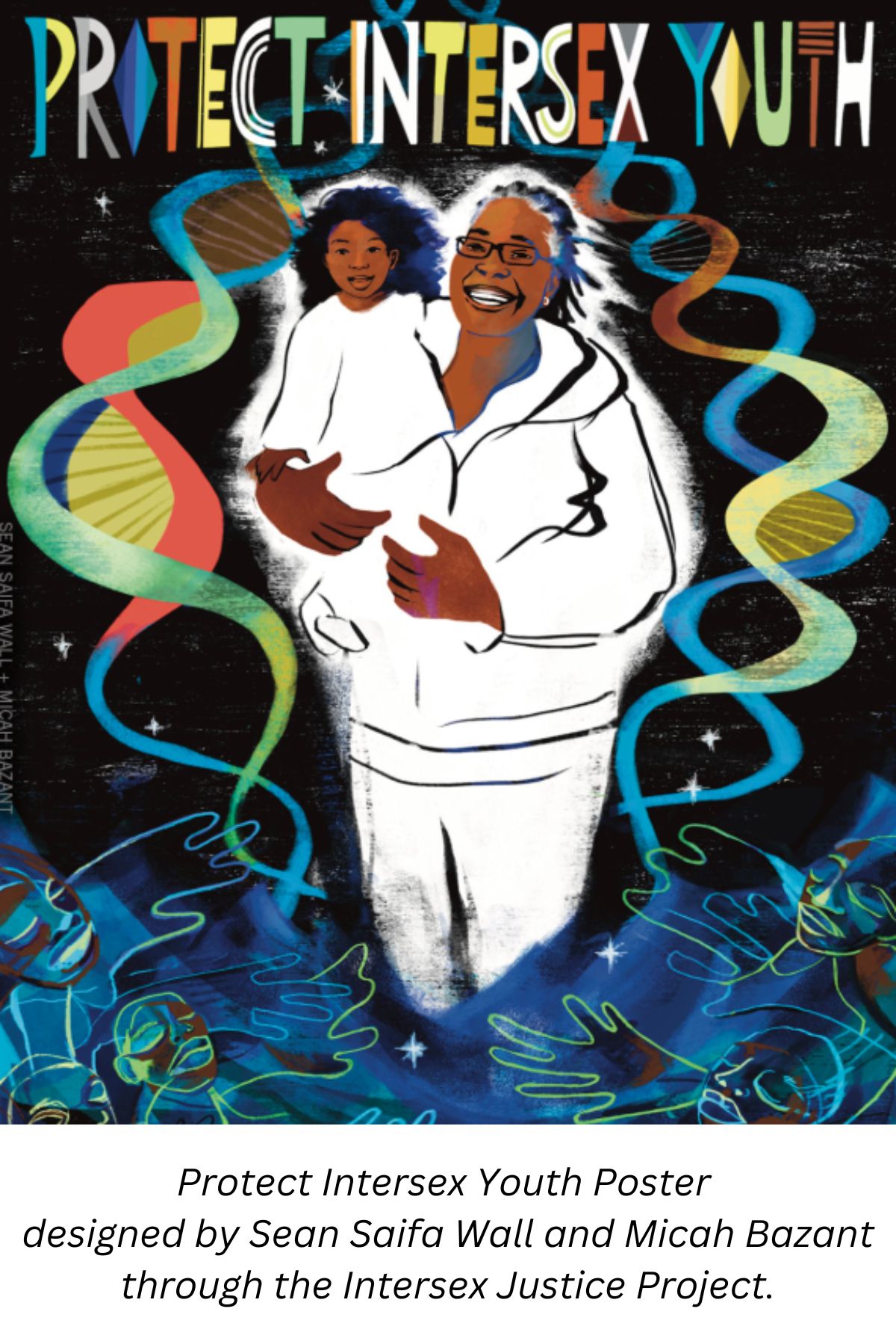
When we consider the intersectionality of sexual orientation and gender identity within the realm of intersex and LGBTQIA+ identities, we must recognize the multifaceted nature of individuals' experiences. For some intersex individuals, navigating aspects of identity may be complex, as their biological sex characteristics may not align with societal expectations of gender. Intersex individuals face a range of challenges in navigating their identities, including medical interventions without their consent, stigmatization, and lack of awareness and understanding from healthcare providers. These challenges highlight the need for clinicians to educate themselves on intersex experiences and provide inclusive and affirming care.
Resources for Clinicians to Support Intersex Patients
While you may be reading this thinking, ‘I don’t know anyone who is intersex,’ or ‘I don’t work with Intersex patients,’ you might be surprised to learn that you probably do! Intersex variations are as common as having red hair. The United Nations Free & Equal Initiative Intersex Fact Sheet states that “According to experts, somewhere between 0.05 percent and 1.7 percent of the global population is born with intersex traits. The upper estimate is bigger than the population of Mexico.” So, if you know, or have ever seen someone with red hair, you probably know or have seen someone who is intersex too.
Clinicians who are looking to better support their intersex patients can benefit from accessing resources specifically tailored to understanding and addressing the unique needs of this community. Two great Intersex-led organizations to help educate you and provide support to intersex patients and their caregivers are InterACT Advocates for Intersex Youth and InterConnect.

While you may be reading this thinking, ‘I don’t know anyone who is Intersex,’ or ‘I’ve never treated a patient who is Intersex’ you might be surprised to find that 1.7% to 4% of people are Intersex, according to Zeeman and Aranda (2020) in their 2020 article A Systematic Review of the Health and Healthcare Inequalities for People with Intersex Variance.
According to Haghighat, et. al (2023) in their article Intersex people's perspectives on affirming healthcare practices: A qualitative study, “Intersex people have variations in their sex characteristics that do not exclusively fall within binary definitions of male and female.” These variations can be chromosomal, hormonal, gonadal, or anatomical (Cochetti, Monro, Vecchietti, & Yeadon-Lee [2020] and Haghighat, et. al [2023]).
Intersex folx are often seen by multiple healthcare providers throughout their lifetime, including pelvic rehab practitioners. However, one thing that most don’t know, is that historically; Intersex folx have been very mistreated and pathologized by healthcare workers. Many Intersex folx have been given non-medically necessary and non-consensual surgical procedures and hormone treatments over the years; and unfortunately, some of these practices are still occurring around the world even today. Intersex folx have also been treated by providers with inaccurate education and inadequate training needed to provide care to Intersex populations, leaving many patients who are Intersex being the ones who educate their own medical providers about their variations and healthcare needs. Tiffany Jones (2018) also mentions in her article Intersex Studies: A Systematic Review of International Health Literature that even language in the medical literature is inaccurate and inadequate when describing Intersex populations (Jones, 2018).
All Upcoming Continuing Education Courses

Pelvic Function Level 1 - Satellite - Milwaukee WI - July 12 - 13 2025 - SOLD OUT
Jul 12 2025 - Jul 13 2025

Modalities and Pelvic Function - In-Person - Houston TX - July 12 - 13 2025
Jul 12 2025 - Jul 13 2025
Pelvic Function Level 1 - Satellite - Denver CO - July 12 - 13 2025 - SOLD OUT
Jul 12 2025 - Jul 13 2025




Pelvic Function Level 1 - Satellite - Des Moines IA - July 26 - 27 2025 - SOLD OUT
Jul 26 2025 - Jul 27 2025

Pelvic Function Level 1 - Satellite - Minneapolis MN - July 26 - 27 2025 - SOLD OUT
Jul 26 2025 - Jul 27 2025

Pelvic Function Level 1 - Satellite - Paso Robles CA - July 26 - 27 2025 - SOLD OUT
Jul 26 2025 - Jul 27 2025

Pelvic Function Level 1 - Satellite - St. Augustine FL - July 26 - 27 2025
Jul 26 2025 - Jul 27 2025

Pelvic Function Level 1 - Satellite - Virginia Beach VA - July 26 - 27 2025 - SOLD OUT
Jul 26 2025 - Jul 27 2025


Pelvic Function Level 1 - In-Person - Chicago IL - August 2 - 3 2025 - SOLD OUT
Aug 2 2025 - Aug 3 2025



Menopause Transitions and Pelvic Rehab - Remote Course - August 9 - 10 2025
Aug 9 2025 - Aug 10 2025







Pelvic Function Level 2C - Satellite - Palm Beach FL - August 16 - 17 2025
Aug 16 2025 - Aug 17 2025

Pelvic Function Level 2C - Satellite - New Orleans LA - August 16 - 17 2025
Aug 16 2025 - Aug 17 2025
Pelvic Function Level 2C - Satellite - Paso Robles CA - August 16 - 17 2025
Aug 16 2025 - Aug 17 2025

Pediatrics Level 1 - Treatment of Bowel and Bladder Disorders - Remote Course - August 23 - 24 2025
Aug 23 2025 - Aug 24 2025

Pelvic Function Level 1 - Satellite - Jacksonville FL - August 23 - 24 2025
Aug 23 2025 - Aug 24 2025

Pelvic Function Level 1 - Satellite - Chicago IL - August 23 - 24 2025 - SOLD OUT
Aug 23 2025 - Aug 24 2025


Pelvic Function Level 1 - Satellite - Hermosa Beach CA - August 23 - 24 2025
Aug 23 2025 - Aug 24 2025

Rehabilitative Ultrasound Imaging Pelvic Health Satellite Lab Course - Self-Hosted - September 5 - 7 2025
Sep 5 2025 - Sep 7 2025
Rehabilitative Ultrasound: Orthopedic Topics Satellite Lab Course - Self-Hosted - September 5 - 6 2025
Sep 5 2025 - Sep 6 2025

Rehabilitative Ultrasound Imaging Pelvic Health Satellite Lab Course - Indianapolis IN - September 5 - 7 2025
Sep 5 2025 - Sep 7 2025