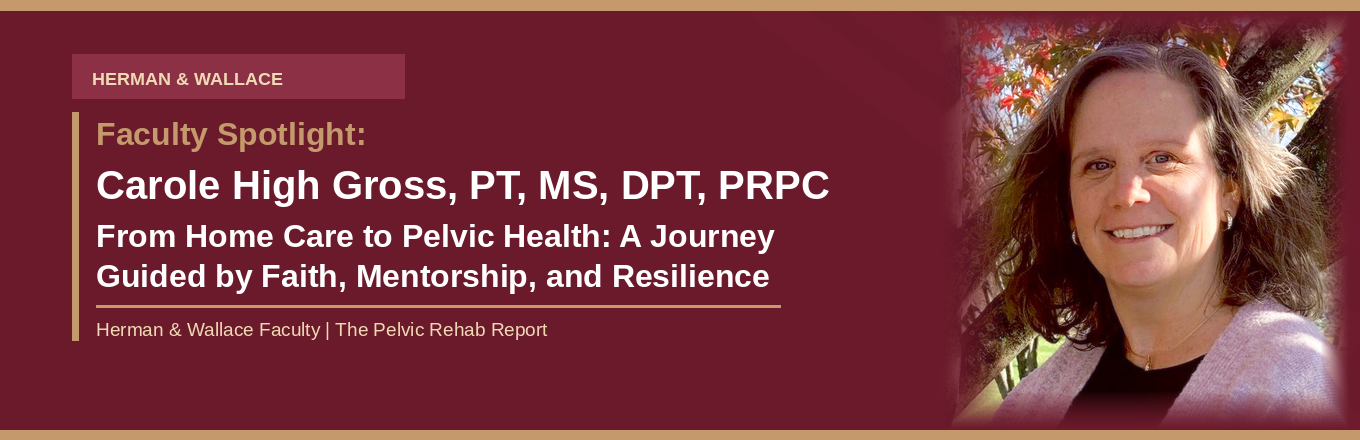

From Home Care to Pelvic Health: A Journey Guided by Faith, Mentorship, and Resilience
Sometimes the most meaningful career paths aren’t the ones we plan. For Herman & Wallace faculty member Carole High Gross, PT, MS, DPT, PRPC, the road to becoming a leader in pelvic health rehabilitation was shaped by unexpected challenges, pivotal relationships, and a willingness to trust the journey even when the destination wasn’t yet visible.
We recently sat down with Carole to talk about her career, her calling, and the work that drives her. What unfolded was one of the most compelling stories of resilience and purpose we’ve heard.
A Career Built on Breadth
Carole’s career in physical therapy spans more than three decades. After earning her Master of Science in Physical Therapy from Thomas Jefferson University in 1992, she worked across nearly every clinical setting imaginable: pediatrics, aquatics, outpatient orthopedics, inpatient rehab, contract work, and home care, which she loved most. She built a deep clinical foundation long before pelvic health was on her radar.
Then life intervened.
Carole was diagnosed with breast cancer, followed by a rare chronic leukemia called hairy cell leukemia. She also lives with CIDP, a neurological condition that significantly impacted her mobility. At one point, she was using a walker, a wheelchair, and a scooter for community outings. Clinical work, at least the way she’d always done it, was no longer an option.
But Carole’s response was characteristically forward-looking: her brain was still working, so she went back for her doctorate.
Getting Back Into the Swing of Things
When Carole enrolled in her Doctor of Physical Therapy program at Arcadia University, the same institution where she’d started her undergraduate education years earlier (she lovingly calls them her “bookend university”), the transition wasn’t easy. She recalls sitting on her bed, textbooks in hand, wondering why she was putting herself through it.
But she found a way to reframe the challenge. She hadn’t forgotten how to learn. She’d simply had a very long summer. That simple mindset shift became a guiding mantra. Every time Carole faces a challenge in her health, her career, or her education, she reminds herself that she’s just getting back into the swing of things.
Walking Through the Door
As Carole neared the end of her DPT, she knew she couldn’t return to home care. She felt pulled toward something but didn’t know what it was. She describes it as trusting a GPS where someone else can see the full route, but she can only see the next turn on the screen.
Then, in a matter of days, a series of small, seemingly random events changed the trajectory of her career.
A friend convinced her to stop by a retirement party. There, she bumped into Kathy Sumner, a PT she’d worked with 20 years earlier. Kathy invited Carole to visit a pelvic health clinic she ran with Janet Whelan Drake, who Carole now works alongside as a Lead Teaching Assistant at Herman & Wallace.
When Carole walked through the clinic door, the feeling was immediate and unmistakable. She was home.
Kathy and Janet became Carole’s mentors. Weekends of hands-on training. Patients brought in for teaching opportunities. Encouragement to pursue coursework. The small-room private practice setting turned out to be the perfect environment for someone navigating mobility challenges, a place where Carole could not only survive, but thrive.
The timing was ideal. Her DPT program required a semester-long research project on a topic of interest, and Carole channeled everything into developing her Belly After Baby program for postpartum women, with Kathy and Janet guiding her every step of the way.
Eating Disorders and Pelvic Health: A Critical Connection
Today, Carole is a Pelvic Clinical Rehabilitation Specialist at Jefferson Health Lehigh Valley in Pennsylvania, where she treats patients of all genders with pelvic, bowel, bladder, and abdominal concerns. She holds her Pelvic Rehabilitation Practitioner Certification (PRPC) and serves as both an instructor and Lead Teaching Assistant at Herman & Wallace.
Her course, Eating Disorders and Pelvic Health Rehabilitation: The Role of a Rehab Professional, fills a critical gap in pelvic health education. Individuals with eating disorders frequently present with the exact symptoms pelvic rehab professionals treat every day: constipation, bloating, abdominal pain, pelvic organ prolapse, urinary dysfunction, and pelvic pain. Yet the connection between eating disorders and pelvic health is often overlooked.
As Carole explains, pelvic health providers aren’t going to diagnose or treat eating disorders, but they absolutely can and should be asking the right questions. They can observe, support, refer, and provide manual and educational tools that make a real difference in someone’s recovery journey. Sometimes, a pelvic health clinician is the first provider to notice the signs and gently guide someone toward help.
The course has received outstanding reviews, with clinicians praising its depth and Carole’s ability to connect the bigger picture, the multidisciplinary web of providers that supports individuals with eating disorders, with the specific, actionable skills pelvic health professionals can bring to the table.
Research at the International Level
Beyond Herman & Wallace, Carole serves on the Pelvic Workgroup of the International Consortium on the Ehlers-Danlos Syndromes and Hypermobility Spectrum Disorders, facilitated by the Ehlers-Danlos Society. In 2024, the workgroup published a landmark paper in PLOS ONE, a multidisciplinary, multinational effort co-creating evidence-based clinical guidelines for the management of pregnancy, birth, and postpartum recovery in individuals with hypermobile Ehlers-Danlos syndrome (hEDS) and hypermobility spectrum disorders (HSD).
The workgroup is currently finalizing a paper focused on pelvic health concerns in individuals with hEDS and HSD, with additional publications expected through 2026 and into 2027, including updates to diagnostic criteria and guidance across multiple clinical domains.
Carole is passionate about the screening role pelvic health professionals can play for hypermobility. As she describes it, asking just a few simple questions about a history of joint subluxations, dislocations, or being “super bendy” can start to connect dots that no one else has connected. Many individuals with hypermobility present with pelvic dysfunction, GI issues, chronic pain, skin changes, and temperature sensitivities. Pelvic health clinicians may be the first to notice that these seemingly unrelated issues share a common thread.
A Philosophy of Mentorship
One theme that runs through every chapter of Carole’s story is mentorship. She was mentored into pelvic health by Kathy and Janet. She was encouraged to take that first Pelvic Floor Level 1 course by people who believed in her when she wasn’t sure she believed in herself. And now, she pays it forward: mentoring new clinicians, serving as boots on the ground at satellite courses, and fostering the collaborative, family-like learning environment that she believes is the heart of what Herman & Wallace does best.
Her advice to clinicians who feel overwhelmed by the breadth of pelvic health education?
“Keep your focus on the step you’re on. Don’t look up at the full staircase. There’s no timeline. One course, one skill, one patient at a time, and before you know it, you’ll have built something incredible underneath you.”
About Carole
Carole High Gross, PT, MS, DPT, PRPC (she/her) earned her Doctorate of Physical Therapy from Arcadia University in 2015 and her Master of Science in Physical Therapy from Thomas Jefferson University in 1992. She works as a Pelvic Clinical Rehabilitation Specialist at Jefferson Health Lehigh Valley and serves as a Lead Teaching Assistant and instructor at Herman & Wallace, where she created and teaches Eating Disorders and Pelvic Health Rehabilitation: The Role of a Rehab Professional. Carole is a member of the Pelvic Workgroup of the Ehlers-Danlos International Consortium and has a special interest in working with individuals living with eating disorders and hypermobility throughout the pregnancy and postpartum journey. She is a dedicated mentor for growing pelvic professionals and focuses on team building and program development.
Learn From Carole
Ready to explore the intersection of eating disorders and pelvic health rehabilitation? Carole’s course is designed to expand your clinical lens, build your confidence in screening and observation, and equip you with practical tools to support individuals with eating disorders on their recovery journey.
Eating Disorders and Pelvic Health Rehabilitation: The Role of a Rehab Professional
Remote Course | October 4–5, 2025 | Live via Zoom
Your patients deserve comprehensive care, and you deserve the knowledge to deliver it. Register today at hermanwallace.com. Spots are limited.
All Upcoming Continuing Education Courses

Rehabilitative Ultrasound Imaging Pelvic Health Satellite Lab Course - Self-Hosted - April 17 - 19 2026
Apr 17 2026 - Apr 19 2026

Rehabilitative Ultrasound Imaging Pelvic Health Satellite Lab Course - Edmond OK - April 17 - 19 2026
Apr 17 2026 - Apr 19 2026

Pelvic Function Level 2B - Satellite - Bethpage NY - April 18 - 19 2026 - SOLD OUT
Apr 18 2026 - Apr 19 2026

Pelvic Function Level 1 - Satellite - Seattle WA - April 18 - 19 2026 - SOLD OUT
Apr 18 2026 - Apr 19 2026

Pelvic Function Level 1 - Satellite - Salt Lake City UT - April 18 - 19 2026 - SOLD OUT
Apr 18 2026 - Apr 19 2026
Pelvic Function Level 1 - Satellite - Newberg OR - April 18 - 19 2026 - SOLD OUT
Apr 18 2026 - Apr 19 2026

Menopause Transitions and Pelvic Rehab - Remote Course - April 18 - 19 2026
Apr 18 2026 - Apr 19 2026

Pelvic Function Level 1 - Satellite - Wichita KS - April 18 - 19 2026 - SOLD OUT
Apr 18 2026 - Apr 19 2026
Oncology of the Pelvic Floor Level 2A - Remote Course - April 18 - 19 2026
Apr 18 2026 - Apr 19 2026
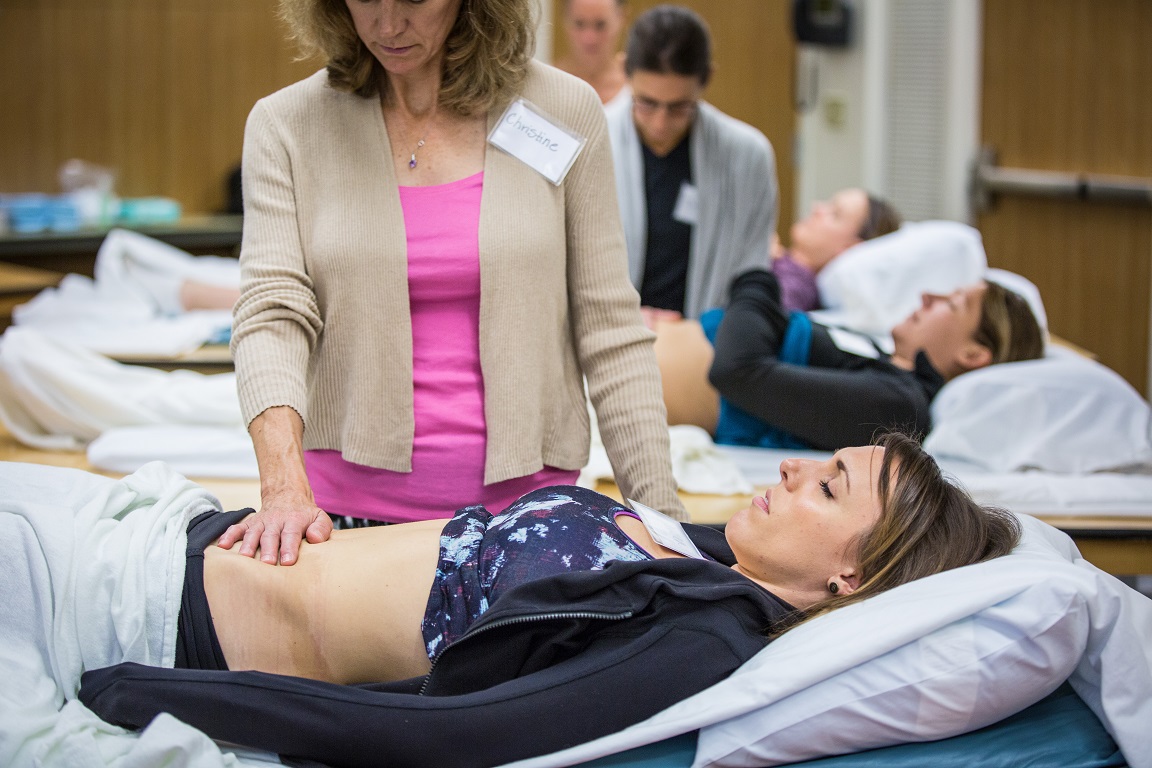

Pelvic Function Level 1 - Satellite - St. Augustine FL - April 18 - 19 2026
Apr 18 2026 - Apr 19 2026

Pelvic Function Level 1 - Satellite - Minneapolis MN - April 18 - 19 2026 - SOLD OUT
Apr 18 2026 - Apr 19 2026



Pelvic Function Level 1 - Satellite - Colorado Springs CO - April 18 - 19 2026
Apr 18 2026 - Apr 19 2026









Pelvic Function Level 2B - Satellite - Nashotah WI - May 9 - 10 2026 - SOLD OUT
May 9 2026 - May 10 2026


Mobilization of the Myofascial Layer - Satellite Lab Course - Torrance CA - May 15 - 17 2026
May 15 2026 - May 17 2026
Mobilization of the Myofascial Layer - Satellite Lab Course Self-Hosted - May 15 - 17 2026
May 15 2026 - May 17 2026
Mobilization of the Myofascial Layer - Satellite Lab Course - McKinney TX - May 15 - 17 2026
May 15 2026 - May 17 2026
Mobilization of the Myofascial Layer - Satellite Lab Course - Bradenton FL - May 15 - 17 2026
May 15 2026 - May 17 2026

Mobilization of the Myofascial Layer - Satellite Lab Course - Atlanta GA - May 15 - 17 2026
May 15 2026 - May 17 2026

Pediatrics Level 2 - Adv Pediatric Bowel and Bladder Disorders - Remote Course - May 16 - 17 2026
May 16 2026 - May 17 2026

Pelvic Function Level 1 - In-Person - Bridgewater NJ - May 16 - 17 2026 - SOLD OUT
May 16 2026 - May 17 2026