Rectal sensation testing is a fundamental component in the evaluation of anorectal function, particularly in patients with constipation, fecal incontinence, and other defecatory disorders. For pelvic rehabilitation practitioners, a thorough understanding of rectal sensory thresholds and the appropriate use of rectal balloon catheters is essential for accurate assessment and effective intervention.
What Is Rectal Sensation Testing?
Rectal sensation testing assesses a patient’s ability to perceive rectal distension at incremental volumes. This procedure is typically performed using a rectal balloon catheter during anorectal manometry or as a stand-alone test. The method allows for quantification of rectal sensory function and compliance, both of which are key elements in normal defecation mechanics.
The key sensory thresholds measured include:
- First Sensation: The initial perception of rectal filling.
- Desire to Defecate: The volume at which the patient feels the urge to evacuate.
- Maximum Tolerable Volume (MTV): The largest volume the patient can tolerate without discomfort.
These parameters provide insight into the sensitivity and distensibility of the rectal wall, guiding clinicians in differentiating between various types of anorectal dysfunction.
Normative Values and Clinical Significance
Recent studies have provided reference values for rectal sensory thresholds in healthy populations. For example, Grando et al. (2024) reported a mean maximum tolerable volume of approximately 150 mL with a standard deviation of 30 mL in healthy subjects. Deviations from these norms may indicate abnormal sensory processing. Elevated thresholds can be indicative of rectal hyposensitivity, commonly associated with functional constipation, whereas reduced thresholds may reflect rectal hypersensitivity, which is often observed in patients with fecal incontinence (Jiang et al., 2023).
Understanding these normative values enables clinicians to identify sensory alterations contributing to disordered defecation and to develop targeted rehabilitation plans.
Clinical Application of Rectal Balloon Catheters
Rectal balloon catheters serve as both diagnostic and therapeutic instruments in pelvic rehabilitation. In the diagnostic context, they facilitate precise measurement of rectal sensory thresholds and compliance. Therapeutically, balloon catheters are used in rectal balloon retraining or sensory biofeedback programs, which aim to improve rectal awareness, enhance coordination of pelvic floor musculature, and promote normalization of rectal compliance.
Incorporating rectal balloon techniques into practice allows clinicians to:
- Differentiate Disorders: Identifying whether symptoms are due to hyposensitivity or hypersensitivity.
- Personalize Interventions: Designing biofeedback or neuromodulation therapies based on individual sensory profiles.
- Monitor Progress: Tracking changes in sensory thresholds over time to assess treatment efficacy.
Advancing Clinical Competency
To further develop competence in this area, practitioners are encouraged to participate in the upcoming course, Anorectal Balloon Catheters: Introduction and Practical Application, scheduled for December 7, 2025. This course provides comprehensive instruction in the use of rectal balloon catheters for assessment and treatment, including practical demonstrations and case-based learning.
Expanding proficiency in rectal sensation testing and rectal balloon catheter application enhances the clinician’s ability to evaluate anorectal function accurately, design individualized rehabilitation programs, and optimize patient outcomes.
References
- Grando, L. M., Halfvarson, J., & van Nieuwenhoven, M. (2024). Rectal Sensory and Compliance Testing: A Method Comparison Study between High-Resolution Anorectal Manometry and Barostat Investigations. Diagnostics, 14(4), 351. https://doi.org/10.3390/diagnostics14040351
- Jiang, Y., et al. (2023). Clinical significance and related factors of rectal sensory thresholds in patients with functional defecation disorders. Frontiers in Medicine. https://doi.org/10.3389/fmed.2023.1119617
- Xiao, C. F., et al. (2024). Influence of the examination position and distension medium on rectal sensory testing in patients with functional constipation. Diagnostics. https://doi.org/10.3390/diagnostics14040351
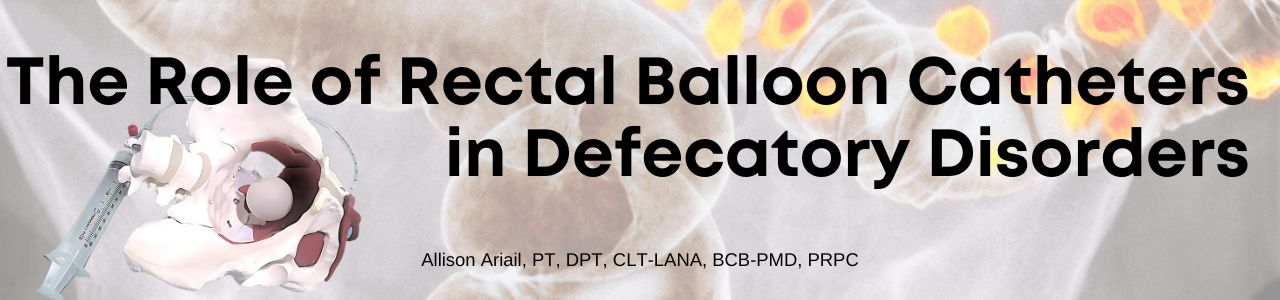

When it comes to treating defecatory disorders, particularly fecal incontinence and chronic constipation, innovation can be a game changer. Enter rectal balloon catheters—a tool that, despite initial discomforting imagery, offers significant benefits for patients struggling with these conditions.
At first glance, the thought of a balloon being inserted into the anus may provoke apprehension. However, it's essential to understand that the size of these balloons is smaller than that of an average bowel movement, making their use far more manageable than one might expect. The primary role of these catheters is to provide sensory retraining in the anal canal, an aspect of treatment that is otherwise challenging to achieve.
Numerous studies have highlighted the effectiveness of rectal balloon catheters. For instance, research by Bright et al. in 2005 showed that when patients squeeze to retain a balloon, it effectively mimics the physiology of defecation. This process aids in improving maximal anal squeeze pressures, a vital aspect of bowel control.
As the study states, “External anal sphincter contraction is difficult for some patients to perform on request. With traction on a balloon catheter, anal squeeze pressures improved in most patients. This indicates that many patients perform maximal anal squeeze pressures better once that muscle group has been tested in a more normal physiological function.”
This revelation underscores the potential of balloon catheters in not only retraining muscle function but also in enhancing patient confidence during bowel movements.
The key to success with rectal balloon catheters lies in careful patient selection. Not every patient will benefit from this approach, but for those who do, the results can be transformative. Many have reported significant improvements in their ability to manage symptoms and regain control over their bowel functions.
Are you still feeling apprehensive about integrating balloon catheters into your practice?
It’s understandable. Take a course to build your confidence and learn how to use this remarkable clinical tool. In Anorectal Balloons: Introduction and Practical Applications you will learn the research that supports the use of balloon catheters, as well as evaluation and treatment techniques using anorectal balloons. You will participate in a lab to ensure proper handling. Anorectal Balloons: Introduction and Practical Applications is an online course lasting 5.5 hours. Join me on December 14 to learn more about anorectal balloon catheters so that you can add this tool to your clinical repertoire.
Rectal balloon catheters may initially seem daunting, but they represent an essential advancement in the treatment of defecatory disorders. With the right training and patient selection, you can add this remarkable clinical tool to your repertoire and make a profound difference in your patients' lives.
Resources:
Bright T, Kapoor R, Voyvodich F, Schloithe A, Wattchow D. The use of a balloon catheter to improve evaluation in anorectal manometry. Colorectal Dis. 2005 Jan;7(1):4-7. doi: 10.1111/j.1463-1318.2004.00698.x. PMID: 15606577.
AUTHOR BIO:
Allison Ariail, PT, DPT, CLT-LANA, BCB-PMD, PRPC
 Allison Ariail has been a physical therapist since 1999. She graduated with a BS in physical therapy from the University of Florida and earned a Doctor of Physical Therapy from Boston University in 2007. Also in 2007, Dr. Ariail qualified as a Certified Lymphatic Therapist. She became board-certified by the Lymphology Association of North America in 2011 and board-certified in Biofeedback Pelvic Muscle Dysfunction by the Biofeedback Certification International Alliance in 2012. In 2014, Allison earned her board certification as a Pelvic Rehabilitation Practitioner. Allison specializes in the treatment of the pelvic ring and back using manual therapy and ultrasound imaging for instruction in a stabilization program. She also specializes in women’s and men’s health including conditions of chronic pelvic pain, bowel and bladder disorders, and coccyx pain. Lastly, Allison has a passion for helping oncology patients, particularly gynecological, urological, and head and neck cancer patients.
In 2009, Allison collaborated with the Primal Pictures team for the release of the Pelvic Floor Disorders program. Allison's publications include: “The Use of Transabdominal Ultrasound Imaging in Retraining the Pelvic-Floor Muscles of a Woman Postpartum.” Physical Therapy. Vol. 88, No. 10, October 2008, pp 1208-1217. (PMID: 18772276), “Beyond the Abstract” for Urotoday.com in October 2008, “Posters to Go” from APTA combined section meeting poster presentation in February 2009 and 2013. In 2016, Allison co-authored a chapter in “Healing in Urology: Clinical Guidebook to Herbal and Alternative Therapies.”
Allison works in the Denver metro area in her practice, Inspire Physical Therapy and Wellness, where she works in a more holistic setting than traditional therapy clinics. In addition to instructing Herman & Wallace on pelvic floor-related topics, Allison lectures nationally on lymphedema, cancer-related changes to the pelvic floor, and the sacroiliac joint. Allison serves as a consultant to medical companies, and physicians.
All Upcoming Continuing Education Courses

Rehabilitative Ultrasound Imaging Pelvic Health Satellite Lab Course - Self-Hosted - April 17 - 19 2026
Apr 17 2026 - Apr 19 2026

Rehabilitative Ultrasound Imaging Pelvic Health Satellite Lab Course - Edmond OK - April 17 - 19 2026
Apr 17 2026 - Apr 19 2026

Pelvic Function Level 2B - Satellite - Bethpage NY - April 18 - 19 2026 - SOLD OUT
Apr 18 2026 - Apr 19 2026

Pelvic Function Level 1 - Satellite - Seattle WA - April 18 - 19 2026 - SOLD OUT
Apr 18 2026 - Apr 19 2026

Pelvic Function Level 1 - Satellite - Salt Lake City UT - April 18 - 19 2026 - SOLD OUT
Apr 18 2026 - Apr 19 2026
Pelvic Function Level 1 - Satellite - Newberg OR - April 18 - 19 2026 - SOLD OUT
Apr 18 2026 - Apr 19 2026

Menopause Transitions and Pelvic Rehab - Remote Course - April 18 - 19 2026
Apr 18 2026 - Apr 19 2026

Pelvic Function Level 1 - Satellite - Wichita KS - April 18 - 19 2026 - SOLD OUT
Apr 18 2026 - Apr 19 2026

Oncology of the Pelvic Floor Level 2A - Remote Course - April 18 - 19 2026
Apr 18 2026 - Apr 19 2026

Pelvic Function Level 1 - Satellite - St. Augustine FL - April 18 - 19 2026
Apr 18 2026 - Apr 19 2026

Pelvic Function Level 1 - Satellite - Minneapolis MN - April 18 - 19 2026 - SOLD OUT
Apr 18 2026 - Apr 19 2026



Pelvic Function Level 1 - Satellite - Colorado Springs CO - April 18 - 19 2026
Apr 18 2026 - Apr 19 2026











Pelvic Function Level 2B - Satellite - Nashotah WI - May 9 - 10 2026 - SOLD OUT
May 9 2026 - May 10 2026


Mobilization of the Myofascial Layer - Satellite Lab Course - Torrance CA - May 15 - 17 2026
May 15 2026 - May 17 2026
Mobilization of the Myofascial Layer - Satellite Lab Course Self-Hosted - May 15 - 17 2026
May 15 2026 - May 17 2026

Mobilization of the Myofascial Layer - Satellite Lab Course - McKinney TX - May 15 - 17 2026
May 15 2026 - May 17 2026

Mobilization of the Myofascial Layer - Satellite Lab Course - Bradenton FL - May 15 - 17 2026
May 15 2026 - May 17 2026

Mobilization of the Myofascial Layer - Satellite Lab Course - Atlanta GA - May 15 - 17 2026
May 15 2026 - May 17 2026

Pediatrics Level 2 - Adv Pediatric Bowel and Bladder Disorders - Remote Course - May 16 - 17 2026
May 16 2026 - May 17 2026

Pelvic Function Level 1 - In-Person - Bridgewater NJ - May 16 - 17 2026 - SOLD OUT
May 16 2026 - May 17 2026